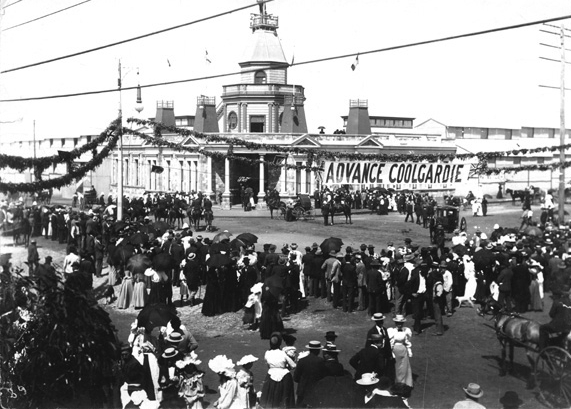
Image: Coolgardie 1899, (Source: Wikimedia Commons)
October marks Family History Month in Victoria. Regardless of where we live, this is a timely reminder that history and family history are closely connected. While a family tree can tell us who our ancestors were, understanding the history of the places and times in which they lived can help us understand their lives, their choices and the circumstances around them.
For family historians, looking beyond the names, dates and relationships in our family tree can add a whole new dimension to our research. The broader historical picture can provide context, answer questions and sometimes even help solve a research puzzle.
After all, our ancestors didn’t live in a vacuum. Their lives were shaped by the world around them: wars, economic shifts, new industries, epidemics, migration, and the sudden rise or fall of local communities.
Looking beyond the family story
Take the common family story that an ancestor simply “went to the city for work.” Rather than accepting that at face value, looking at local history might reveal a different catalyst, the arrival of a railway, a devastating drought, or a sudden factory closure that forced their hand.
Research by our own AAGRA members brings this to life perfectly. One member tracked a young man in South Australia who was told to “Go West, young man, and make your fortune.” Sure enough, he later appeared in Coolgardie, Western Australia, during the famous gold boom.
Interestingly, he wasn’t a gold prospector. The records show he was actually working as a town policeman. Whether he ever intended to dig for gold remains a mystery, but knowing the chaotic nature of the Coolgardie gold rush explains why a young South Australian headed west, even if he ended up policing the goldfields rather than mining them.
Another member’s research uncovered a WWI returning soldier who married almost immediately upon returning to Australia. Family lore insisted he had married his long-time, pre-war sweetheart.
The records told a completely different story. The woman he married was someone he met while serving overseas, and his repatriation file documented the complex arrangements made for her passage to Australia. Exploring the wider military and repatriation records completely changed the narrative. Further digging even revealed the original sweetheart, who had actually married someone else while he was away!
While we’ll never know who moved on first, the records show that the passed-down family story had simply smoothed over a much more complicated, human sequence of events.
Reading Between the Lines
When a document raises more questions than answers, it helps to pause and look at what was happening in the wider community at that exact moment:
- Sudden moves: Was a relocation driven by a new rail line, an agricultural shift, or a localized economic downturn?
- Vanishing occupations: If a trade suddenly disappears from the records, what was happening to that industry? Was a new technology making their skills obsolete?
- Disappearing acts: When an ancestor vanishes entirely, could wartime service, institutionalization, or migration to another colony explain the gap?
- Unusual record formats: Government structures, legislation, and registration practices changed constantly. For Australian researchers, remembering the pre-Federation colonial borders is vital. Before 1901, each colony ran its own race with its own laws, which explains why an ancestor’s paperwork in Victoria looks entirely different from their records in New South Wales.
Look beyond the genealogy records
When researching an ancestor, it is easy to concentrate on the records specifically designed for family history — birth, death and marriage certificates, electoral rolls, census or population records, passenger lists and similar sources.
These are important, but they are only part of the historical picture.
Newspapers, maps, local histories, photographs, manuscripts, directories, court records, business records, school records and oral histories can all help place an ancestor within the world in which they lived.
Local histories, old maps, newspapers, court directories, school registers, and even accounts of weather patterns or economic depressions can hold the missing keys. Sometimes, the breakthrough we need isn’t a document mentioning our ancestor by name at all; it’s an article about a mine closure or a new law that suddenly makes their next move make perfect sense.
So, the next time you look at a name in your family tree, don’t just ask, “Who were they?” Step back and ask, “What was the world like that shaped them?”