Like most tools, what you get out of it will depend on how you use it.
Here are some of my suggestions:
- Limit your own personal information.
Remember, anything you write will be saved into AI, so don’t include anything you wouldn’t want the world to know.
- The important first step is to do your homework.
Work out what you need or want AI to help you with.
- Give the right command to achieve the best outcome.
This may not seem important, but it is – Try asking AI different ways to achieve the best outcome. Here are some suggestions:
Ask Ai to re-write or write something as the following:
A historian, professional researcher, student, family historian etc.
Also
Ask for it to be written in a way that the average person can understand and don’t forget to specify that it should use Australian standards and spelling.I asked AI to briefly suggest ways a historian can use AI, the result:
Research & Analysis
- Summarising long documents to speed up source review
- Spotting patterns across archives such as recurring names or themes
- Transcribing handwritten material for easier searching – OCR
- Translating historical texts to get quick working versions
Writing & Interpretation
- Drafting outlines for articles, exhibitions, or reports
- Refining tone for academic, public, or diplomatic audiences
- Checking factual details like dates and locations
Public History & Engagement
- Creating exhibition captions that are concise and accessible
- Preparing educational materials such as timelines or worksheets
- Organising oral‑history transcripts and identifying themes
Digital Humanities
- Generating metadata for collections
- Building timelines from scattered sources
- Cleaning messy datasets for analysis
If you’d like, I can tailor this specifically to your heritage‑writing and community‑engagement work in Tasmania, or shape it into a version suitable for a committee report or public‑facing document.
As you can see, AI recognises me because I frequently ask it to find information related to Tasmania and history. Over time, AI becomes familiar with your interests! It has also given me a suggestion at the end.
Here some other uses:
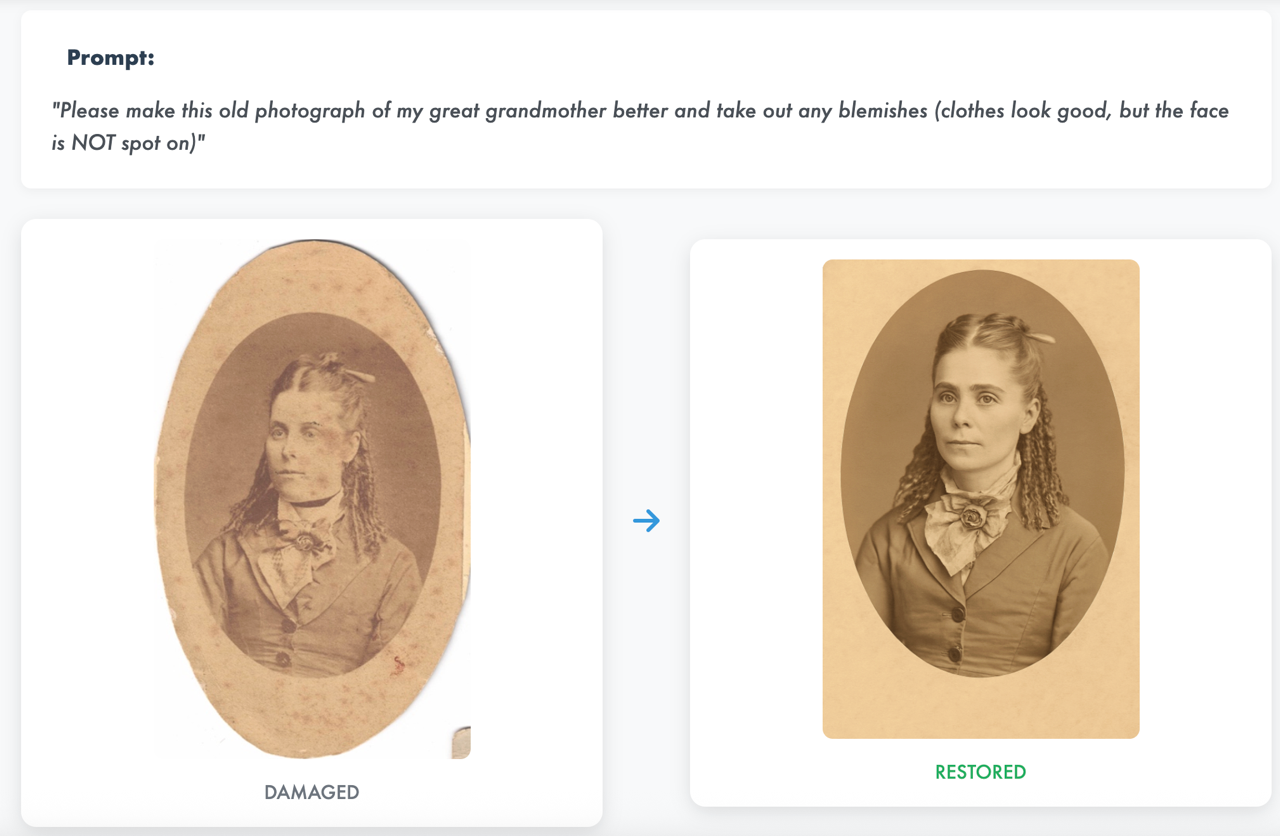
- Photo enhancement and or restoration
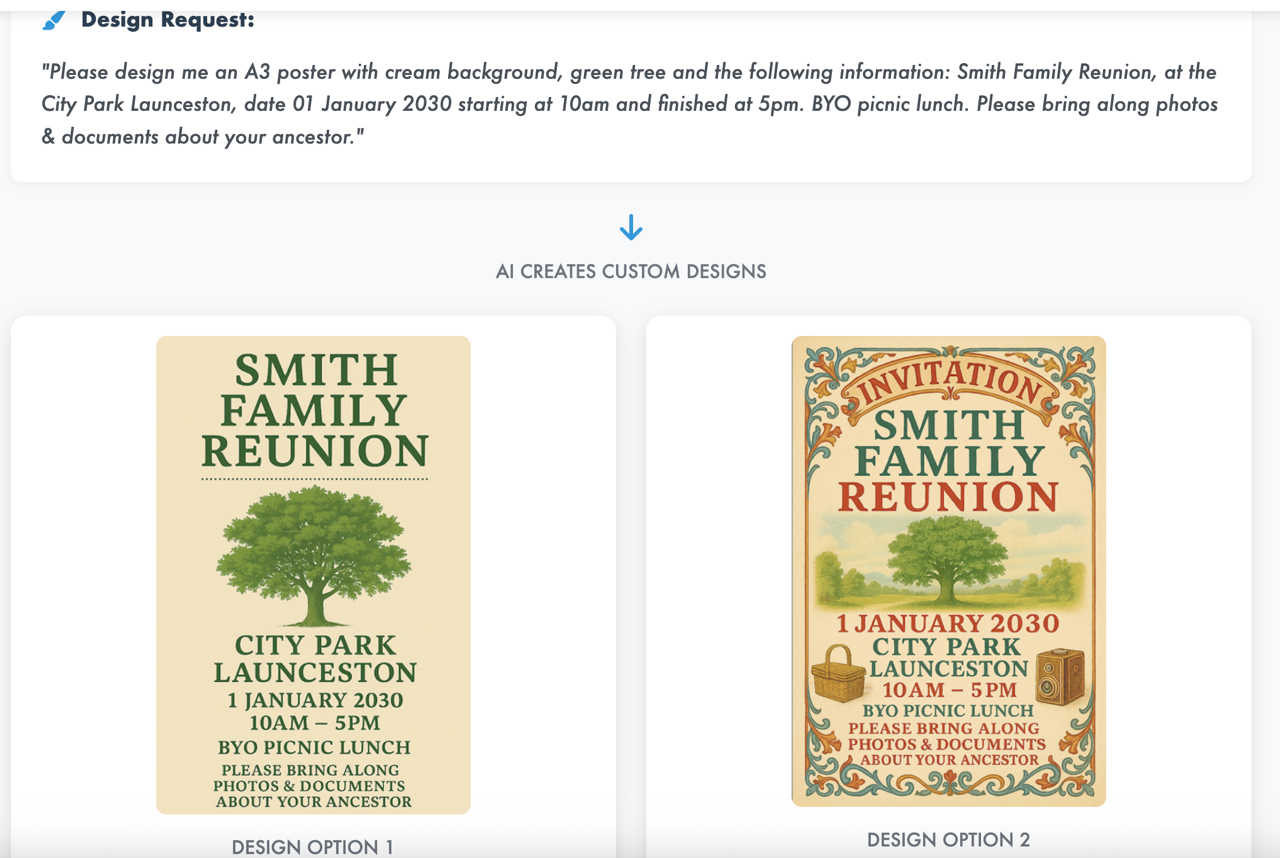
- Creating: flyers, brochures, display panels, letter heads, logos etc.
- Proof Reading
- Grammar, spelling and sentence construction
- Find facts about a place, events or people
- Creating tables & data
- Creating a timeline from a report
- Designing a book, report or pamphlet
- Researching information – ALWAYS CHECK SOURCES
Recognise Bias, AI outputs may reflect historical or societies biases in training data.
Verify Information – always cross-check Al generated content with reliable sources before publishing your research.
Use AI as an assistant not a replacement for critical thinking and human judgement.
Stay informed about AI capabilities and limitations as technology evolves.
Today, most genealogy sites, such as Ancestry, are using AI to provide you with search result, hints and other information. However, these results can sometimes be incorrect—so always double-check them.
Remember: AI chatbots are powerful research companions, but they are not infallible. Understanding their capabilities and limitations is essential for effective genealogy research. Always approach AI-generated content with a critical eye and prioritise human oversight in your family history work.
I have not gone into details of what AI Bots or Platforms to use – there are so many, some are free for short use. See my website for further information and examples: https://www.maureenmartinferris.com.au/ai.html