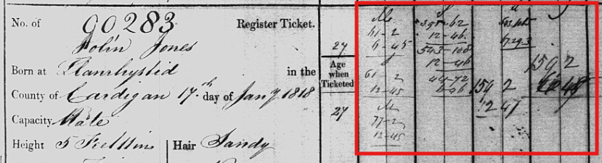
Image courtesy of FindMyPast. Original records held by The National Archives (UK), reference BT 119/46. Crown Copyright expired.
For professional genealogists and record agents tracing 19th-century merchant mariners in the United Kingdom, navigating the National Archives’ (TNA) series BT113 (Register of Seamen’s Tickets, 1845–1854) and BT115 (Alphabetical Register of Masters) has historically presented a specific, frustrating challenge. The yearly columns tracking “Reported Voyages” frequently list only numerical codes, long described in archival guides as unresolvable or “unintelligible.”
A major new indexing initiative has successfully cracked this numerical system, providing professional researchers with a powerful new tool to trace clients’ seafaring ancestors. The Port Rotation Numbers Index is now live and fully searchable, adding over 120,000 entries to the maritime record pool.
Methodology and Origin
The index was born from a methodology developed by Western Australian researcher Peter Hamersley (Family History WA). Hamersley identified that the mysterious codes actually comprised two critical components: a ship’s unique Port Rotation Number (PRN) for a given year (using three digits for foreign trade and two for home trade) coupled with its specific Port of Registry number (e.g., 434-93 indicating Port #93, Stockton).
Recognizing that indexing a benchmark census year would catch the vast majority of active mid-century merchant hulls, Hamersley focused on the year 1851. He collaborated with Pete and Jan Owens of the Crew List Index Project (CLIP) to coordinate a three-year transcription project. The team number-chunked data from separate historical indexes (BT162/19 and BT111) to allow for exact interpolation of individual ports, effectively mapping nearly every merchant ship active in a UK port in 1851.
Application for Professional Record Agents
When undertaking client research in merchant shipping, this index bridges the gap between a seaman’s personal service record and the physical location of the corresponding crew lists.
Using the index allows researchers to:
- Decode BT113 & BT115 Notation: Input raw numerical codes directly into the database to extract a confirmed vessel name, official port of registry, and tonnage.
- Streamline Crew List Searches: Locate the exact film numbers or boxes needed to retrieve full Crew Lists and Agreements held under TNA Series BT98, saving hours of speculative indexing.
- Reconstruct Maritime Career Timelines: Track a mariner’s consecutive service voyages, transition from seaman to master, and geographical movement across the critical mid-19th-century period.
Though developed from an initial concept by a WA-based researcher, the international scale of this database makes it an essential bookmark for any professional dealing with British maritime ancestry.
The database, along with detailed case studies on how to interpret variations in the numbering patterns, can be accessed freely at the CLIP portal: crewlist.org.uk